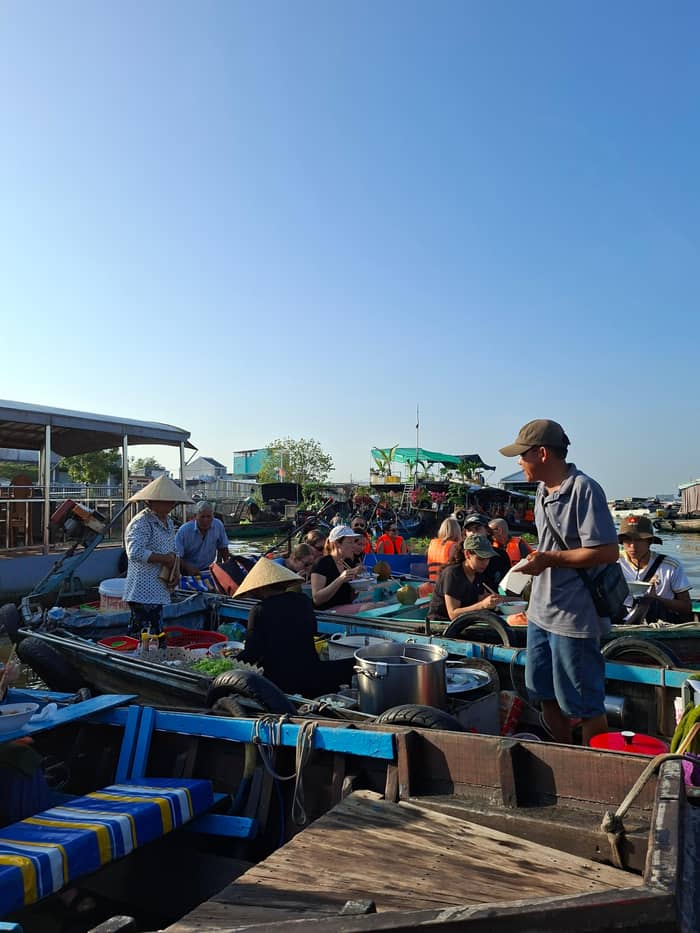
6 to 6.5 hours
Small-group dawn boat
A Can Tho morning
- Starts5:30 AM
- BreakfastOn board
- Reviews1,827
See your group's price
Answer in brief
A floating market is a market held on boats, and Cai Rang is the largest wholesale floating market in the Delta, where sellers hang samples on long poles.
Market essentials
Look at 4 options
Enter how many travel to see the market and compare the morning tours.
GetYourGuide's starting prices, converted at the ECB reference rate; exact pricing appears when you book.
What is a floating market, and why does the Mekong Delta still run one at Cai Rang? A pole code, a noodle breakfast and a heritage listing explain it.
Editorial team, cairangfloatingmarket.click · Updated November 16, 2026 · Allow 8 min
Summary view
A floating market is a place where buyers and sellers meet on boats instead of on a pavement. A Mekong Delta floating market is less a gimmick than a habit of geography. The national tourism authority sums it up: the Delta lives on the water, with rivers and canals threading the region and people learning to paddle boats and ride ferries from childhood.6 When the roads are waterways, a market has to be where the traffic is, and the traffic is on the river.
Can Tho shows the logic well. The authority pictures a busy city whose commerce streams down the Hau River without pause.7 The river here carries more than scenery: it is the route by which fruit leaves the farm and reaches the traders who sell it on. Cai Rang sits on that traffic, which is why it is called the biggest wholesale market on the water anywhere in the Delta.3 Think of the river as the main street and the market as the junction where everything meets.
Wholesale is the key word. The boats at Cai Rang are not stalls laid out for visitors; they are working vessels of produce changing hands, with fruit traded by the sackful from boat to boat.1 Smaller rowboats then thread between the big ones selling coffee, snacks and noodles.8 A visit is therefore a visit to a working river port first and a breakfast stop second, and that order explains most of what you see and hear on the water.
Water places compared
| Place | What the sources say | How it works |
|---|---|---|
| Cai Rang | Largest wholesale floating market in the Delta3 | Hawkers hang samples on long poles2 |
| Chau Doc | Smaller than Cai Rang and no less photogenic16 | No hawking, samples hung high on poles15 |
| Cai Be | Markets in full swing at first light17 | Market life plays out on the water18 |
| Con Son | An islet of about 70 hectares in the Hau River19 | About 50 houseboats raising fish20 |
Statements are the national tourism authority's and the Can Tho tourism portal's, each kept to what the page says about its own place.3
Anyone who has tried to buy from a moving boat knows the difficulty: how do you know what is on board when the hull is stacked with sacks and crates? The Delta's answer is a pole. The Can Tho tourism portal calls the bamboo pole known as Cay Beo the most distinctive feature of the market, a pole of 3 m to 5 m on which all kinds of goods hang to invite buyers.14 The cargo is shown, not announced.
The national tourism authority describes the same system in plainer terms. At the front of each boat, sellers hang samples of what they carry from long poles, which tells customers what that boat is selling.2 That turns the pole into a menu you can read from across the water. A boat with a pineapple at the top is a pineapple boat, and a buyer can steer toward it without a word being shouted over the engines.
The code is shared across the region, not invented for Cai Rang. At the Chau Doc market, the authority notes, there is no hawking at all, and produce samples hang high on long poles so that possible buyers can see them from a distance.15 Put the markets side by side and the pole looks like the Delta's common language: a quiet way to sell that works the same on a wide river and on a narrow one.
Time on the water
Hours per stop in the itinerary of one 5.5-hour Can Tho small-group morning; the market is the longest single stop.
Official pages give Cai Rang a place on the map but not a birthday. The Can Tho tourism portal sets the market on the Cai Rang river, close to Cai Rang Bridge and the Vo Tanh road that leads toward Phong Dien district.23 No official page used here names a founding year, so treat any exact date you read elsewhere with care. What the sources do agree on is that this is a place that trades every day, not a reconstruction.
What the record does show is recognition. In 2016 Cai Rang floating market was recognised as a national intangible cultural heritage, according to the Can Tho tourism portal, which also counts it among the most interesting attractions of the city.4 Intangible is the right word: the thing recognised is a way of trading, with its poles and its calls and its boats rafted together before sunrise, rather than a monument that could be fenced and ticketed.
The portal adds a cultural detail: the market stages a periodic show of don ca tai tu, a traditional art.24 Don ca tai tu is a style of southern Vietnamese folk music, and its appearance here is a reminder that the river is a stage as well as a wholesale yard. If your trip falls on a performance day it is a bonus, not something to plan around, since the portal says only that the show is periodic.
Pick your angle
Pair what you want from the morning with the right boat.
If I want to understand how trading works
Ask about the poles
Sellers hang samples on long poles so buyers can see each cargo.2
If I want the biggest market
Cai Rang
The authority ranks it as the biggest wholesale floating market in the Delta.3
If I want a quieter look
Add a smaller market
The authority advises visiting a smaller floating market for a close-up look.21
If I want breakfast on the water
Hu tieu by boat
The authority recommends a hu tieu breakfast eaten on the water at dawn.5
If I dislike very early starts
Take the 6:45 AM group
One Can Tho morning meets its guests at 6:45 AM for 5.5 hours.
If I am coming from Saigon
Add a hotel night
The 2-day trip reaches the market at 6:00 AM, after a night in Can Tho.
Ways in
6 to 6.5 hours
A Can Tho morning
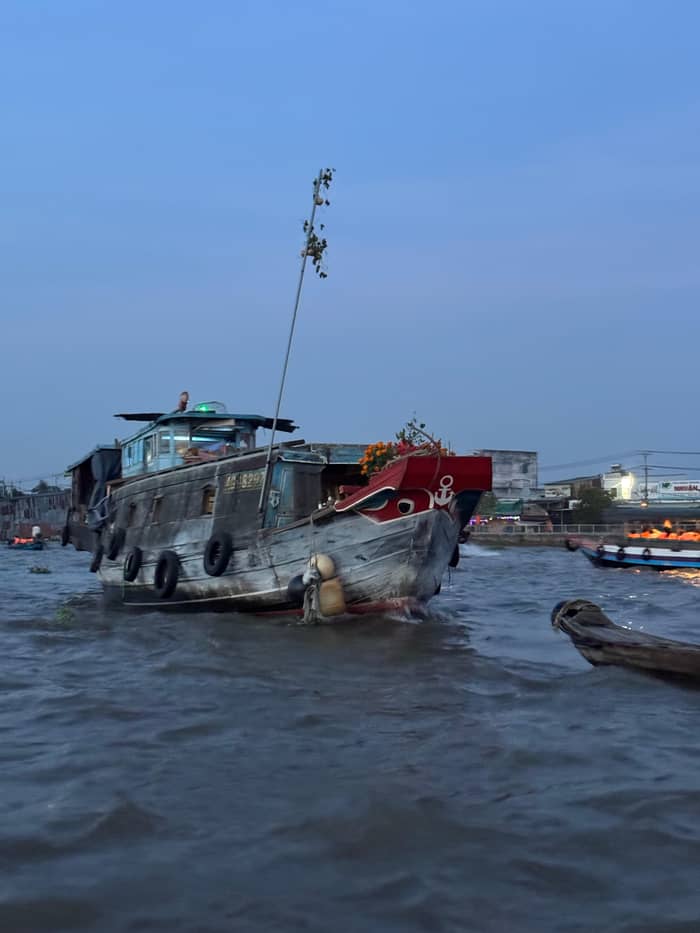
12 hours
Market plus Con Son
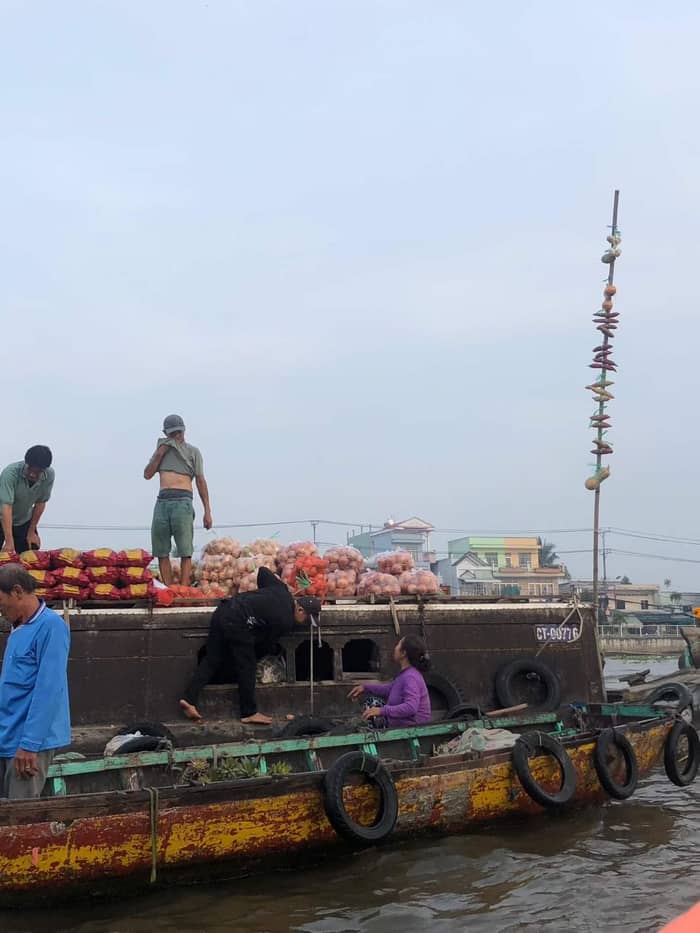
2 days
The trip of this site
Cai Rang is not the only market on the water, and the authority itself urges visitors to see more than one place before they judge the Delta. It advises visiting a smaller floating market as well, to see this Mekong Delta tradition up close.21 A second market shows the same trade at human scale: fewer boats, slower talk and a better chance to see the fruit up close and ask what it is.
Chau Doc has its own market, smaller than Cai Rang and no less photogenic in the authority's words.16 Cai Be is another place where the water counts: at first light its markets are in full swing, and rising early, the authority says, lets you watch market life unfold on the water.17,18 Each has a different personality and a different rhythm, which is why the Delta is better understood as a family of markets than as a single attraction.
Even the water-bound life around Can Tho is not all trading. The portal counts about 50 fishing houseboats around Con Son islet, a floating village where each boat is a family home and the business is fish, not fruit.20 It is a useful contrast with the market: Cai Rang moves goods between boats, while a houseboat raises a single product and sells it on from the same spot, so both are worth seeing in the same trip.
A market morning
Before dawn
The authority advises booking a boat tour the evening before a floating market morning.9
First light
The Cai Rang market starts around 5 AM and the boat should be on the water by 6 AM.10
Peak hours
The busiest stretch, from 5 AM to 8 AM, sees hundreds of boats crowd together.11
On the water
Samples on long poles at the bow let buyers see each cargo from afar.2
Breakfast
A rowboat noodle seller serves a bowl of bun cha ca beside your hull.12
Mid-morning
Once trading is over, small tributaries offer a glimpse of local life, the authority suggests.13
The sensory side is where the market earns its reputation. The authority calls it a riveting show of colour and activity that gets going around 5 AM, and advises being on a boat by 6 AM so that the mist is still lifting off the river and you catch the peak hours.10 The first impression is of hulls rafted together, engines idling and a thicket of poles rising above them, with the light still low and cool.
Vessels large and small trade on the caramel-coloured river, and the colours come from the cargo: pomelos, pineapples and durians among others.1 Smaller boats dart in and out among the bigger vessels, selling breakfast noodles and coffee.13 If you have stood in a farmers' market on land the pattern is familiar. Only the aisles move, and the stalls rock gently with the wake of every passing boat.
Breakfast is part of the show. Hu tieu noodles, the authority says, are best taken on the water at dawn, amid the sounds of the market,5 with a bowl of bun cha ca from a passing noodle seller as the alternative, or a cold pineapple to nibble while you watch.12 Eat slowly, because the boat sways and the broth is hot, and let the vendor decide when your bowl is empty, since refills are easy to arrange.
Video
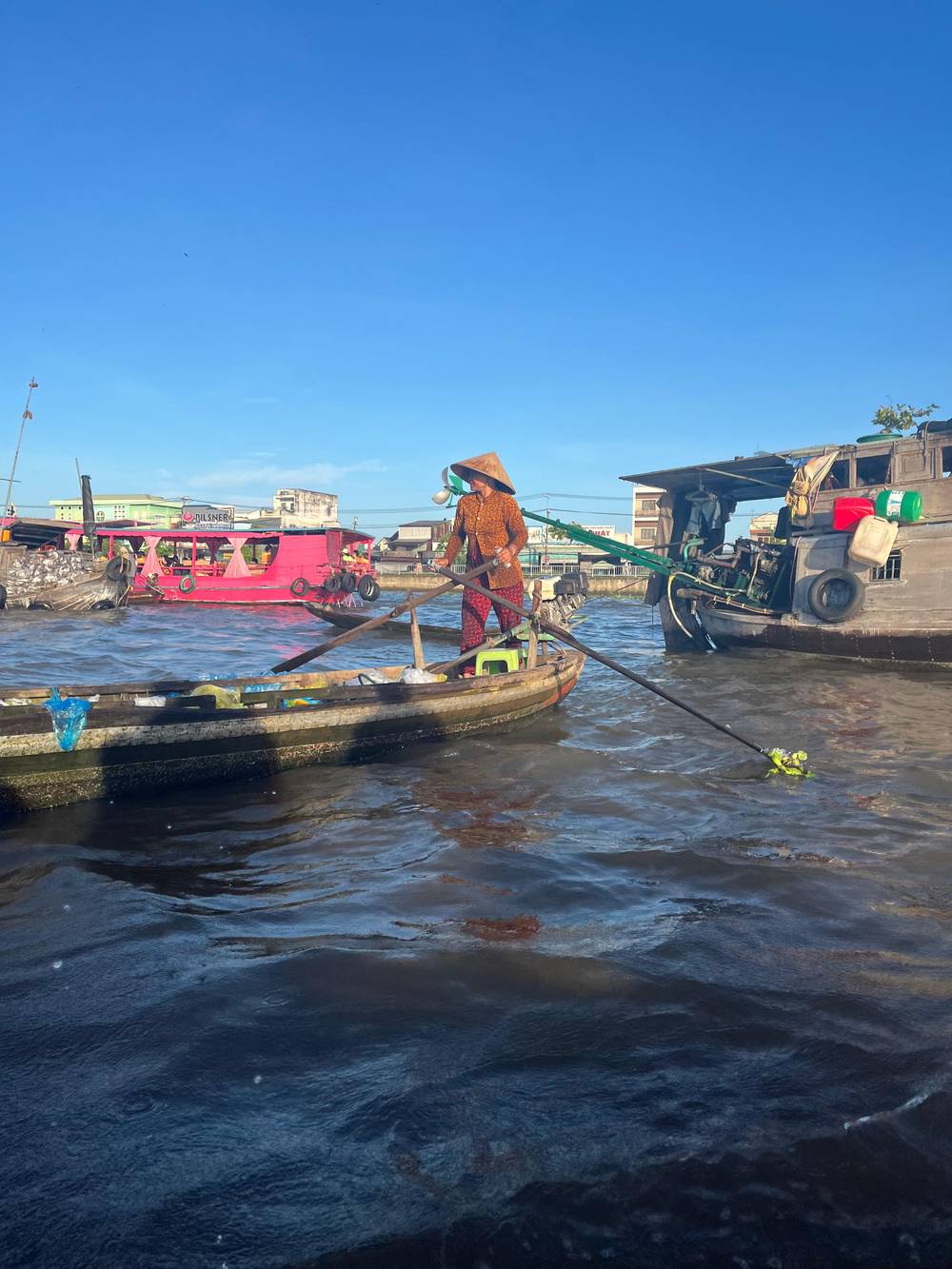
John and Tina on YouTube · Tap play to load the video; not before.
Cruise past stilt houses and barges, see birds swooping over the palms, and boats heading to market heavy with fruit.
People live and work on these boats, which is the reason for manners. The authority's etiquette guide tells visitors to respect privacy and always ask before lifting a camera.27 On a moving boat, ask with a gesture and a smile before pointing a lens at a seller's face; the poles, the stacked fruit and the mist need no permission at all, and they make better pictures anyway, since a face seen from the side of a moving boat rarely comes out well.
Rowers deserve the same courtesy. In the Delta, the authority notes, women typically row sampans standing up as they work the bends and currents of each channel,25 a skill that is easy to overlook until you try to stand in a wobbling boat yourself. Sit low, keep your hands inside the hull and leave the handling of contact with other vessels to the person at the oar, who has done it many times before you.
Buying from a vendor is part of the experience, and the authority says bargaining is common practice in casual markets and shopping hubs.29 Keep small notes in a pocket: the authority says banknotes run upward from 10,000 VND to a top note of 500,000 VND, and that the blue notes of 20,000 VND and 500,000 VND are easy to confuse.30,31 Check the colour twice before you hand over money in poor early light, and count your change before the boat drifts away.
Seeing a floating market means accepting an early start, and the tours differ mainly in where the morning begins. Several small-group mornings from Can Tho reach the market quickly: one meets at 5:30 AM and lasts 6 to 6.5 hours with breakfast on board, another picks up at 5:00 AM and lasts 6.5 hours with a quiet canal and a cacao farm, and a third meets at 6:45 AM for 5.5 hours that include 1.5 hours at the market itself.
From Ho Chi Minh City the choice is between a day of 12 hours that adds Con Son islet, and the 2-day trip of this site, which puts a night in Can Tho before the market so it is the first stop on day 2 at 6:00 AM. Prices start from $28 for the small-group mornings and from $65 for the 2-day trip, and each listing named here can be cancelled without charge until a day before it begins.
Whichever you pick, ask how long the boat spends at the market rather than how many stops the day holds, because the market is the one part of the program that is busiest early and thins out later. The portal gives 5 AM to 8 AM as the best window, with hundreds of boats crowding together to trade.11 A tour that reaches the water after that window has missed the best of what a floating market is, however good its other stops are.
FAQ
Each boat carries samples of its cargo on a long pole at the bow, so buyers can read the stock from a distance.2
The national tourism authority names Cai Rang as the Delta's biggest wholesale floating market and says trading runs from early morning to midday.3
According to the Can Tho tourism portal, 2016 is the year Cai Rang floating market gained national intangible cultural heritage status.4
Sources
Planning a dawn at Cai Rang? Ask a real person here.