6 to 6.5 hours
Small group at dawn
Breakfast on board
- Starts5:30 AM
- BreakfastOn board
- Reviews1,827
Interactive tick list
List of 10 items
Mark items as done. Your progress is saved on this device only.
0 / 10 ready
You are good to go. Pick your date for the river, and the rest is settled.
Book your placeThe sampan under you, the vendor boats around you and the noodle bowl in your hands: a practical guide to Cai Rang breakfast, fruit, cash and manners.
Editorial team, cairangfloatingmarket.click · Updated November 16, 2026 · Allow 8 min
Summary view
Most visitors reach the market in a small wooden boat, and the type matters less than the company. According to the authority, Delta day trips nearly always include a sampan ride among the palm fronds, and it is a must-do photo opportunity.1 One Can Tho morning tour is described as a sampan trip to the Cai Rang floating market, a quiet canal and an organic cacao farm. Mekong Delta floating market boats are low, open and sit right on the waterline, so they are ideal for watching.
You can also hire a boat yourself. The authority notes that you can pay a small fee to charter a rowboat for a few hours and tour the canals near Can Tho, calling at workshops that make rice paper and noodles by hand.7 A hired rowboat is slower than a tour boat but gives you the freedom to stop where you like, and a rower who knows which canals are busy that morning. Agree the price and the length of the trip before you step in.
The Cai Rang floating market boats you share the river with are working vessels, and the rower is usually the most skilled person aboard. The authority observes that women in the Delta typically row sampans while standing, steering through the currents and twists of each waterway.8 Sit low, stay in your seat when other boats draw alongside, and leave the steering to the person holding the oar, however tempting the photograph.
What a boat offers
| Item | What the authority says | Reference or season |
|---|---|---|
| Hu tieu on the water | Eaten at first light amid the market's sounds3 | Street meal reference 45,000 VND13 |
| Coffee from a rowboat | Sold by small boats between the larger vessels2 | Sidewalk coffee reference 25,000 VND14 |
| Pineapple | Nibbled cold while watching the action15 | Bargain gently5 |
| Mangosteen | A fruit worth trying from floating vendors16 | In season May until August17 |
| Rambutan | Bunches found in summer and winter18 | Harvested twice a year18 |
The prices are the authority's reference figures for street food and coffee, not boat prices, and they vary with location, season and provider.19
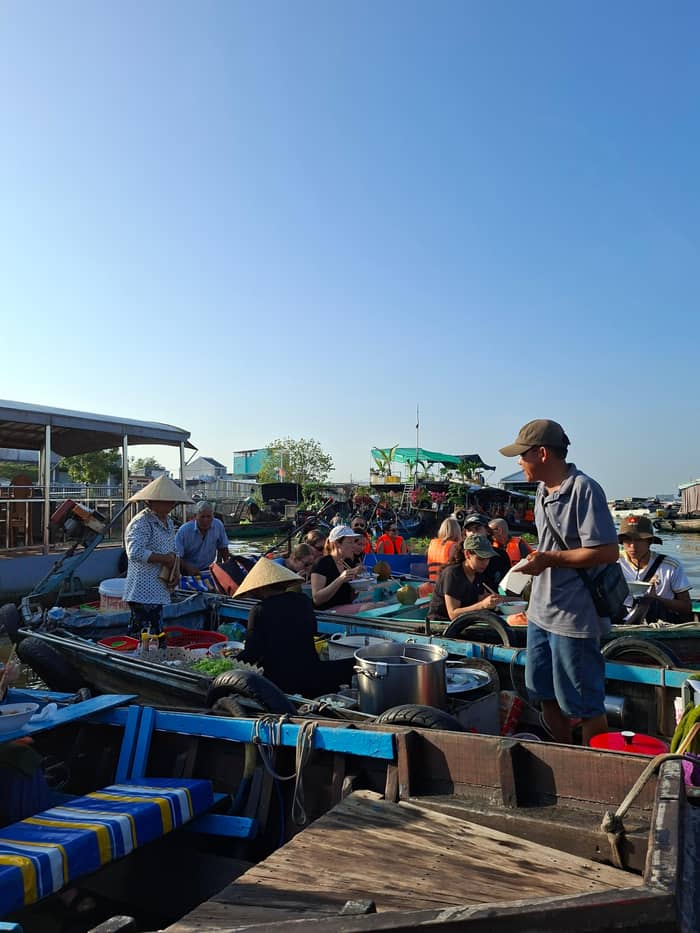
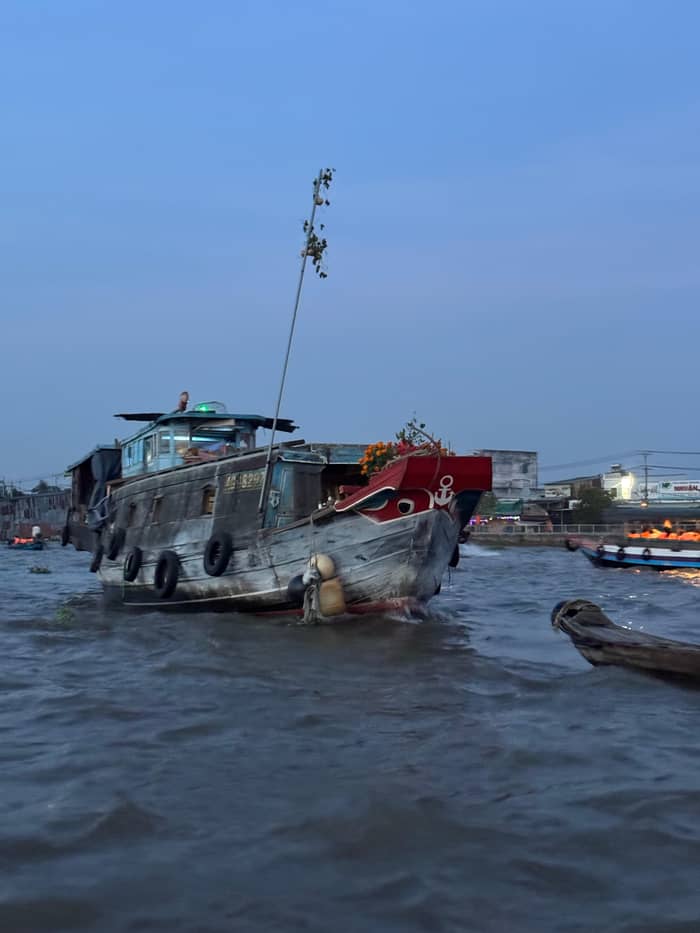
The market works in layers of boats. The big ones carry the wholesale load: the authority describes vessels of all sizes doing business on the caramel-coloured river, with pomelos, pineapples and durians sold by the sackful across the gunwales.9 The small ones carry the retail trade: rowboats that slip among the larger vessels with coffee, snacks and noodles.10 As a visitor you spend your money among the small boats and watch the big ones.
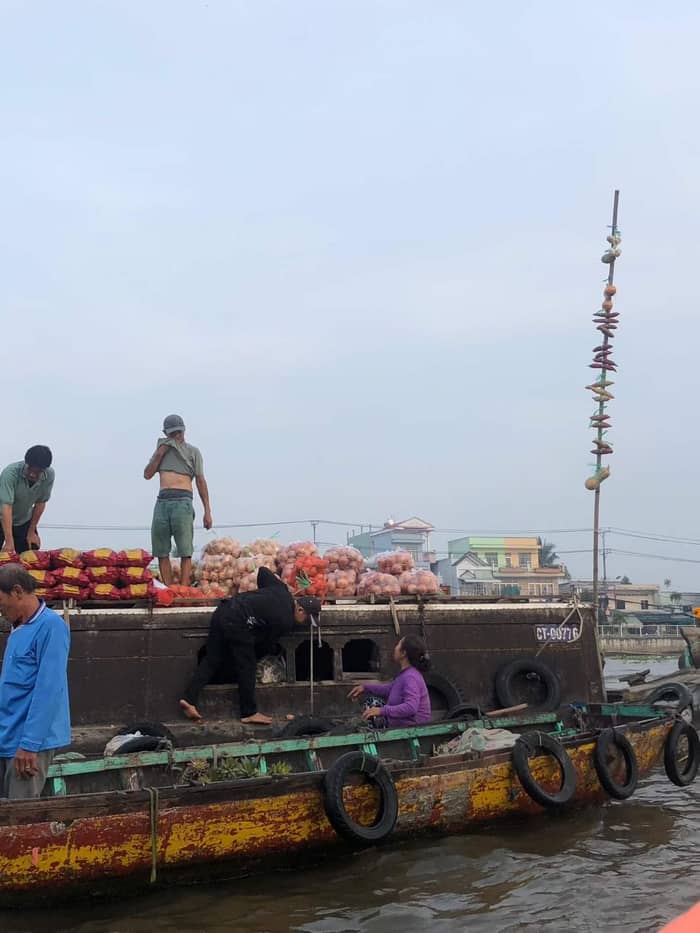
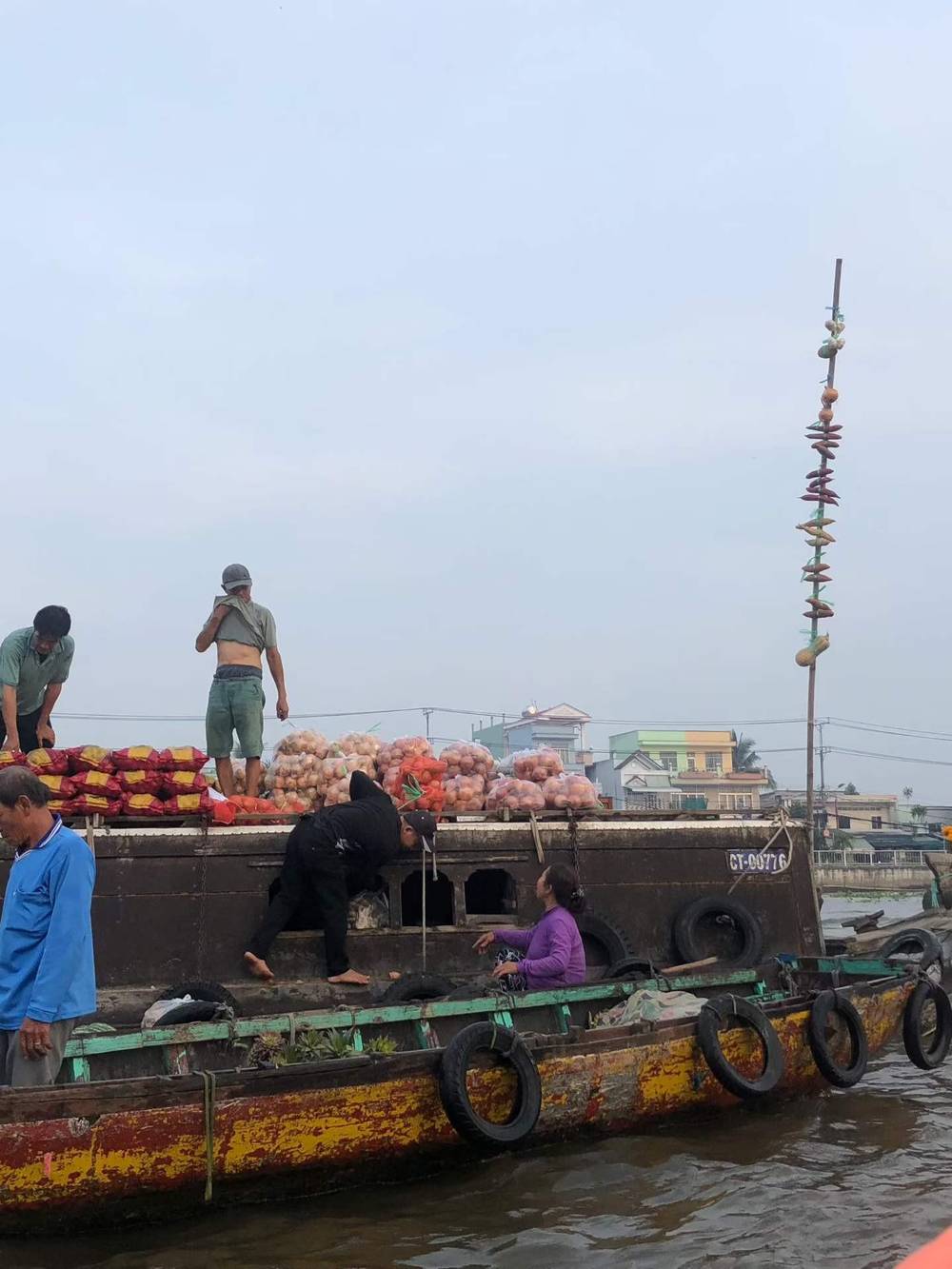
Every wholesale boat tells you what it sells before you reach it. The authority explains that hawkers hang samples of what they sell on long poles at the bow, so customers know what is on offer.11 That is the quickest way to find the fruit you want: scan the poles, pick the colour, and ask your rower to come alongside. A vendor at the bow of a heavily loaded boat will usually sell a few pieces to a visitor, though wholesale is the real business.
Be realistic about the pace. The market is at its busiest in the early window of the morning, and the Can Tho tourism portal says that hundreds of boats crowd together to trade at that hour.12 Boats move, engines run and a noodle seller who was alongside a minute ago is suddenly several hulls away. If you spot something you want, say so at once and your rower will manage the manoeuvre, rather than leaning out to wave.
Length of a boat morning
Durations as the listings give them; the 12-hour day includes long van rides to and from Saigon.
Breakfast is the best reason to bring an appetite, and Mekong Delta floating market food starts with the noodle bowl. The authority's breakfast of choice is hu tieu noodles eaten on the water at first light, among the sounds of the market, and it calls it the best breakfast in Can Tho: tapioca noodles, sliced pork and aromatic herbs in a steaming bowl.3,10 It also suggests stopping next to a noodle vendor for bun cha ca.15 Eat while the broth is hot, since the boat sways and the bowl cools quickly.
Many tours include breakfast. One Can Tho small-group morning includes a Vietnamese breakfast aboard and offers vegetarian choices; another includes a breakfast on the river, and the 12-hour one-day tour includes breakfast and coffee at the market. Whoever has dietary needs should tell the operator the evening before, because the boat cannot improvise a vegetarian bowl once it is moored among the other boats.
A bowl on the boat is not a restaurant meal, and the price should not be compared with one. The authority lists reference prices that vary with location, season and provider, among them a street food meal with iced tea at about 45,000 VND and a sidewalk coffee at about 25,000 VND.19,13,14 Treat these as a sense of scale and ask the vendor for the price before you eat, since a boat has no menu board and no receipt.
Pick your boat
Choose by how you like to travel and a suitable boat follows.
If I want my own pace on the canals
Hire a rowboat
A small fee buys a few hours in a rowboat on the canals near Can Tho.7
If I want breakfast included
A small-group dawn boat
One Can Tho morning serves a Vietnamese breakfast on board.
If I am vegetarian
Tell the operator early
Vegetarian options are available on both Can Tho mornings with advance notice.
If I want to try the fruit
Aim for May to August
That is the peak of the Can Tho orchards and the mangosteen season.20,17
If I only have cash in big notes
Break them first
Street vendors work in cash, so large notes are a nuisance.4
Breakfast on board
6 to 6.5 hours
Breakfast on board
6.5 hours
Breakfast on the river
5.5 hours
Noodle workshop stop
The Delta's fruit is the reason the market exists, and buying some is the easiest way to taste the place. The authority suggests buying whatever catches your eye from the floating vendors, mentioning rambutan, jackfruit and mangosteen as fruit worth trying if you never have.16 Dragon fruit is grown widely in the Mekong Delta, so it is a safe bet at any time of year.25 A cut piece on the spot is far better than a whole fruit carried home.
Season decides what you find. The authority gives May until August as the mangosteen season and says rambutan is harvested twice a year, so bunches can be found in summer and even winter.17,18 It also marks May to August as the high point of the orchards around Can Tho, which is the best time to be on the water if fruit is your priority.20 In the dry months the boats still carry pomelos and pineapples, so no visit leaves you without something to eat.
The same fruit grows on the islets near Can Tho. The tourism portal says pomelos, rambutans, plums and star apples are popularly grown on Con Son, and that fruit bought in the garden is cheap and free of chemicals.26 That makes a garden stop a good follow-up to the market: the boat sells the wholesale load, the orchard lets you pick the fruit yourself. Carry a bag, because a fruit you pay for at the first stall is easy to forget.
Price your party
Enter your group size and compare mornings that include a meal on the water.
Look at 4 options
Enter your group size and compare mornings that include a meal on the water.
GetYourGuide's starting prices, converted at the ECB reference rate; exact pricing appears when you book.
Breakfast step by step
Settle in
A small fee hires a rowboat for a short charter, and the same low seat suits a shared sampan.7
Alongside
Small rowboats weave between the larger vessels selling breakfast noodles and coffee.2
Order
The authority's choice for the water is a steaming bowl of hu tieu.3
Taste
Pomelos, pineapples and durians trade by the sackful on the boats nearby.9
Pay
Street vendors expect cash for small purchases.4
Move on
Afterwards a cruise up a small tributary shows more local life.2
Bargaining is part of buying in a Vietnamese market, and the authority says it is common practice in casual shopping hubs and markets, with a gentle negotiation usually bringing the price down where tourists come in numbers.5 On a boat the rule is the same but the stage is smaller. Ask the price, smile, offer a little less, and accept the answer: a small difference in price is not worth a long exchange across moving water.
Carry small notes. Street vendors work in cash for small purchases, the authority points out, while hotels, restaurants and tour operators accept major cards.4 The notes begin at 10,000 VND and end at 500,000 VND with no coins in use, and a 20,000 VND note can be mistaken for a 500,000 VND one, since both are close shades of blue, so look at the colour before handing one over in poor light.27,28 A pocket of small notes saves an awkward scramble on a moving deck.
A tip is up to you. Tipping is not part of everyday Vietnamese culture, the authority says, though it is spreading among private tour guides, and cafes and restaurants do not expect it.29 Guides and spas see it most, and nobody is bound to leave one.30 If a rower or a guide has made your morning, a tip is welcome, but nobody on the river will chase you for one, and nobody is offended if you do not.
Video
Mắc Ơi on YouTube · Tap play to load the video; not before.
nothing like a breakfast of steaming Hu Tieu noodles served on the water in the early morning, surrounded by the sounds of the market.
The morning starts cool and ends hot. Mist lifts off the river early, and the authority wants you afloat by 6 AM to see it,31 and the south normally sits around 30 degrees in the sun, so the first hour is the coolest you will feel all day.32 Dress in light layers you can remove, in colours that dry fast, and carry a hat; a nón lá, the conical hat, is recommended for sun protection on the sampans.8
The health guidance of the national tourism authority recommends a medical kit with DEET insect repellent and sunscreen.6 Both are worth carrying on the water, where mosquitoes and glare arrive together. The wet season, running from May to November, delivers an afternoon downpour of a few hours on most days, so a light rain jacket belongs in the bag even though the market itself finishes before the rain starts.21
Dress with respect, not just comfort. The authority notes that swimwear is welcome only on the beach or at your resort, and that outside the cities most Vietnamese are traditional and modest in dress.33 Ask before photographing people, as the authority urges.22 Grippy sandals beat flip-flops on a wet hull, and a waterproof pouch for your phone makes sense when spray and sweat arrive together.
The boat is only the first half of a Cai Rang morning. After the floating market the authority suggests cruising small tributaries for a glimpse of local life, where the river narrows and the pace drops.2 Several tours add a noodle workshop, a village or a cacao garden at this point, which is why the market is a single stop in a morning of several hours rather than the whole program.
Lunch is the second meal worth planning. Back in Can Tho the authority suggests a lunch of nem nuong Cai Rang, pork skewers cooked on charcoal and brought with peanut sauce, herbs, pickles and banh hoi noodles,23 and it describes nem nuong as pork kneaded until chewy and chargrilled on the sidewalk, then rolled in rice paper like a burrito.34 Order it the way locals do, with a plate of herbs and plenty of time.
For a wider choice of food the authority points to De Tham street in Can Tho, known locally as food street, and advises picking the busiest spots and pointing at whatever looks good at the next table.24 That advice works on the boat too: follow the crowd to the noodle seller who is busiest, and you will rarely go wrong. Keep the evening free for the riverside, where the promenade of Ninh Kieu Park invites a slow stroll.35
FAQ
Sampans carry most visitors: the authority says a sampan ride nearly always comes with Delta day trips, and one Can Tho morning tour is described as a sampan trip.1
One small-group morning serves breakfast on board, with vegetarian options, and another offers breakfast on the river.
A gentle negotiation is normal; the authority describes haggling as a usual habit in casual markets and shopping hubs.5
Tipping is increasingly common for private tour guides but is not expected in restaurants and cafes.29
Sources
Planning a dawn at Cai Rang? Ask a real person here.